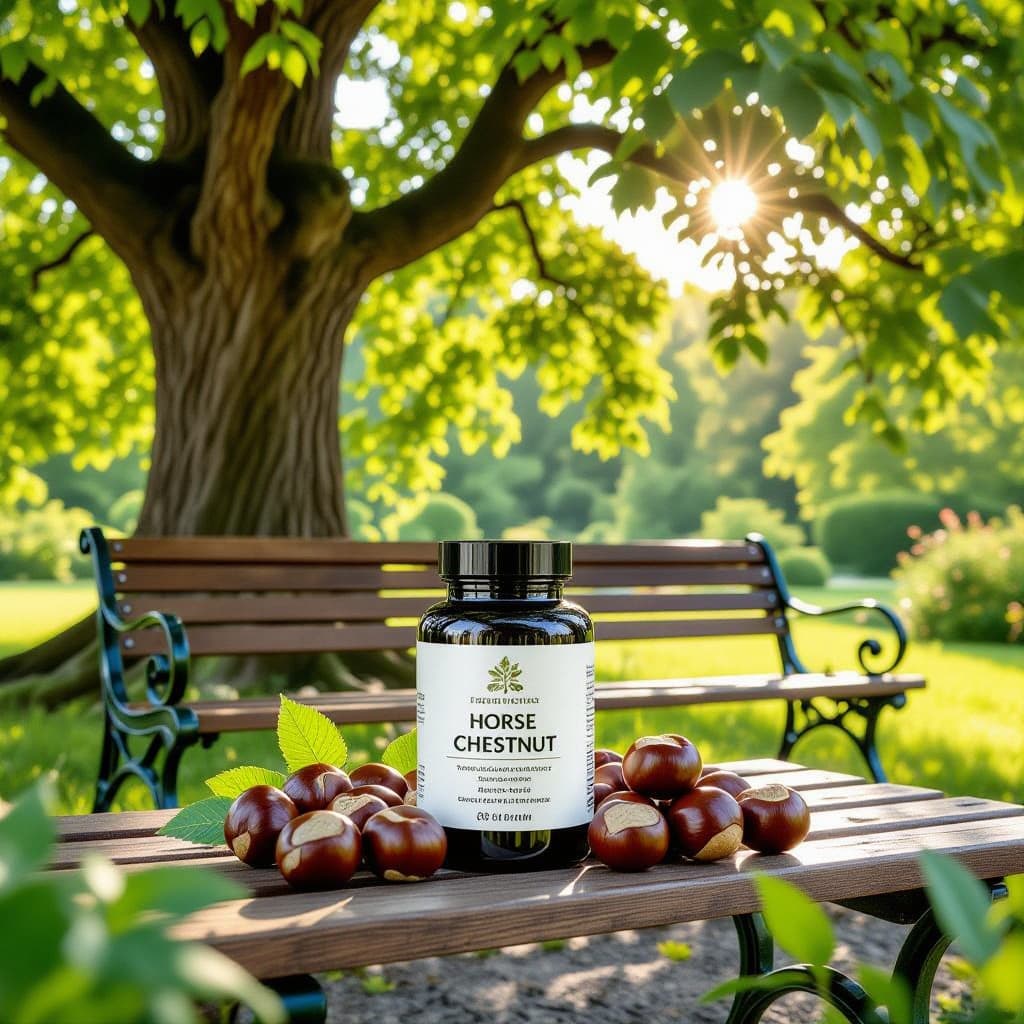
Your Guide to the Vascular Benefits of Horse Chestnut
Horse Chestnut is an extract derived from the seeds or bark of a tree native to the Balkan Peninsula Known for its anti-inflammatory and vein-tonifying properties, it's primarily used to treat varicose veins and chronic venous insufficiency.
Supplement Summary
| Name | Horse Chestnut |
|---|---|
| Category | Herbs & Botanicals |
| Main Uses |
|
| Effectiveness | High, particularly for venous conditions |
| Common Dosage | 300mg twice daily |
| Price Range | $15-30 per month |
| Forms Available | Capsules Creams |
Pros
- ✅ Effective in reducing inflammation
- ✅ Can improve venous circulation
- ✅ May reduce symptoms of varicose veins
Cons / Side Effects
- ❌ May cause mild side effects like dizziness and upset stomach
- ❌ Potential for allergic reactions
- ❌ Not suitable for those with liver or kidney disease
What Is Horse Chestnut?
Horse Chestnut is an extract derived from the seeds or bark of a tree native to the Balkan Peninsula. Known for its anti-inflammatory and vein-tonifying properties, it's primarily used to treat varicose veins and chronic venous insufficiency.
How It Works
The active compound in Horse Chestnut, aescin, has anti-inflammatory effects and can help strengthen veins and capillaries. This leads to improved blood flow and reduced swelling.
Who It's Best For
People suffering from poor circulation, varicose veins, or chronic venous insufficiency.
Who Should Avoid It
Those with liver or kidney disease, or those who are pregnant or breastfeeding.
Dosage & Usage Tips
A typical dosage is 300mg taken twice daily with food. It's best to start with a lower dose to assess tolerance.
Buying Advice & Quality Tips
When choosing a Horse Chestnut supplement, look for products that are standardized to contain 20% aescin, the active compound.
Price & Value
Horse Chestnut is a relatively affordable supplement, offering good value given its multiple health benefits.
Final Verdict
Horse Chestnut is a valuable supplement for those needing circulation support. While it may cause mild side effects, its benefits in treating varicose veins and chronic venous insufficiency are well-documented.
Additional Clinical Research
Based on the provided search results, here are three scientific studies specifically focusing on Horse Chestnut (Aesculus hippocastanum) and its health effects:
RESEARCH SUMMARY: Horse Chestnut
KEY FINDINGS:
Chronic Venous Insufficiency
- Horse Chestnut Seed Extract (HCSE) significantly reduced leg volume by an average of 46.4 ml compared to placebo.
- Patients experienced a 4.1-fold increase in the likelihood of leg pain improvement with HCSE.
- The meta-analysis included 13 randomized controlled trials with 1,051 patients and 3 observational studies with 10,725 patients.
Source: Siebert et al. (2002)
View Research
https://pubmed.ncbi.nlm.nih.gov/12518108/
Periodontitis
- Horse Chestnut Leaf Extract (ALH-L1005) demonstrated significant inhibition of matrix metalloproteinases (MMPs), particularly MMP-2 and MMP-9, in a canine model.
- Clinical indices of periodontitis improved notably after 6 weeks of treatment with ALH-L1005.
- The study involved beagle dogs with experimentally induced periodontitis, treated over a 6-week period.
Source: Kim et al. (2017)
View Research
https://pmc.ncbi.nlm.nih.gov/articles/PMC5489472/
Arm Lymphedema
- An interim report suggested that HCSE might reduce arm lymphedema in breast cancer survivors.
- The study was a double-blind, randomized, placebo-controlled trial assessing the effects of HCSE over a three-month period.
- Specific sample size and detailed results were not provided in the abstract.
Source: Hutson et al. (2004)
View Research
https://ascopubs.org/doi/abs/10.1200/jco.2004.22.90140.8095
RESEARCH QUALITY ASSESSMENT:
- The meta-analysis by Siebert et al. (2002) provides robust evidence due to the inclusion of multiple randomized controlled trials and a large patient population.
- The study by Kim et al. (2017) offers valuable insights but is limited by its animal model; human studies are needed to confirm applicability.
- The interim report by Hutson et al. (2004) indicates potential benefits of HCSE for arm lymphedema; however, the lack of detailed results and sample size information limits the strength of its conclusions.
- Overall, while these studies suggest promising benefits of Horse Chestnut extracts, further large-scale, well-designed human trials are necessary to fully establish efficacy and safety across different conditions.